
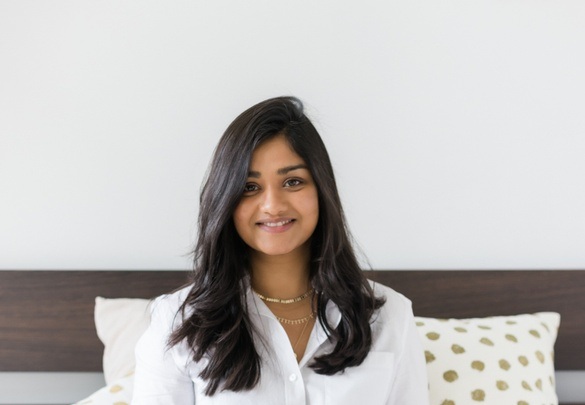
Audrika Rakshit (assistant teacher)
“Be patient toward all that is unsolved in your heart and try to love the questions themselves, like locked rooms and like books that are written in a very foreign tongue. Do not now seek the answers, which cannot be given to you because you would not be able to live them. And the point is, to live everything. Live the questions now. Perhaps you will then gradually, without noticing it, live along some distant day into the answer.” – Rainer Maria Rilke
What inspires you to be an assistant teacher?
I’m most inspired by a deep respect for and joy in the learning process itself, especially the messy, non-linear, human parts of it. I love being in spaces that honour people’s humanity and support them to think for themselves, trust their bodies, and develop a way of working that actually fits who they are, rather than shrinking or shape-shifting into something they’re not.
After two years of this training as a student, I know just how transformative it can be, not only on an intellectual level, but in ways that really land in the body and forever change how you show up in life and work. The second year, in particular, felt initiatory for me: deep, challenging, joyful, and mindblowingly expansive. It stretched me, softened me, and invited me into more of myself, less apologetically.
All this was made possible because we were beautifully held by teachers and an assistant teacher who offered clarity, honest reflection, encouragement, and, of course, some well-timed challenge, whilst still leaving space for experimentation, play, staying with what was present, and the not-knowing. That lived experience is what made me want to offer the same kind of support to the new Year 2 group.
I’m excited to have this space to blend clarity and creativity, steadiness and play, whilst supporting students to become more autonomous, embodied, and confident in their own way of being and working.
About me
My background is a blend of coaching, creativity, and a long-standing curiosity about how people make meaning. Alongside completing this two-year coaching and counselling training, I’ve also got degrees in English Literature and New Media and Digital Culture. An interest in different stories, places, lives, points of view, and the inner narratives we live and love by has always been a throughline in my life.
Before moving fully into this work, I ran my own business in online marketing and also spent some time working in IT. In my marketing work, I was often helping people shape their message and their business, and I started to notice how much energy people put into trying to present a version of themselves they thought others wanted. That gap in the relational field between someone’s inner reality and how they show up externally really stuck with me.
At 22, I moved from India to the Netherlands for love, and lived there for 13 years before moving to Lisbon three years ago. Moving helped me notice and appreciate different cultures (including my own!), and also taught me a lot about transitions, belonging, and identity, along with the grief of losing versions of ourselves and the joy (and discomfort) of everything new we gain over time.
When I became a mum, it felt like jumping into the deep end around my own patterns, and it really deepened my awareness of family dynamics, relationships, and what we unconsciously carry forward.
I love the messy middles of relational work, and I focus on the intersection of the internal and external – the I and the We. My work focuses on relationships, family, grief, and trauma. Outside of this, I love reading, writing, music, walks, and increasingly, stripping things back to the essentials: being here, now.
Why have you chosen the ACC and what did the training bring you?
I found ACC during a period of transition, when I knew I wanted to change how I was working. I was very drawn toward psychotherapy, but needed something with real depth that still felt human and people-centred. What stood out straight away was the care and compassion in ACC’s language and in how they shaped their programmes. Unlike other schools, it asked us to bring in our personal process alongside the professional development, and that was exactly what I was looking for at the time.
The training didn’t just teach me skills and techniques, it also gave me space to slow down, listen more carefully, and stay with complexity rather than rushing to resolve things too quickly. Treating the personal as part of the learning, rather than something to manage separately, changed how I show up with clients and with myself.
The second year, especially working with Judith, was deeply formative. Her practical wisdom and emphasis on professional standards and on being accountable for our journeys from day one felt like a real vote of trust, and that helped me trust myself more.
Most of all, it taught me to approach work and life with compassion, humility, creativity, curiosity, and the courage to simply be present. To trust the autonomy and wisdom of the person in front of me. This now underpins how I work, learn, and relate to others.
Last but not least, it gave me two incredible Intervision groups that I get to call friends and have in my orbit and learn from, and that’s just invaluable.
Who is my hero and why?
I don’t really have a hero in the traditional sense. I’m in awe of everyone I’ve met (and will ever meet) who is curious, reflective, and willing to look in the mirror and actually do the work of naming and working through their inevitable dysfunctions and less-than-helpful patterns, and then choosing something more honest and compassionate in how they engage with themselves and the world. That’s definitely not for the faint-hearted, and I’m endlessly inspired by it.