

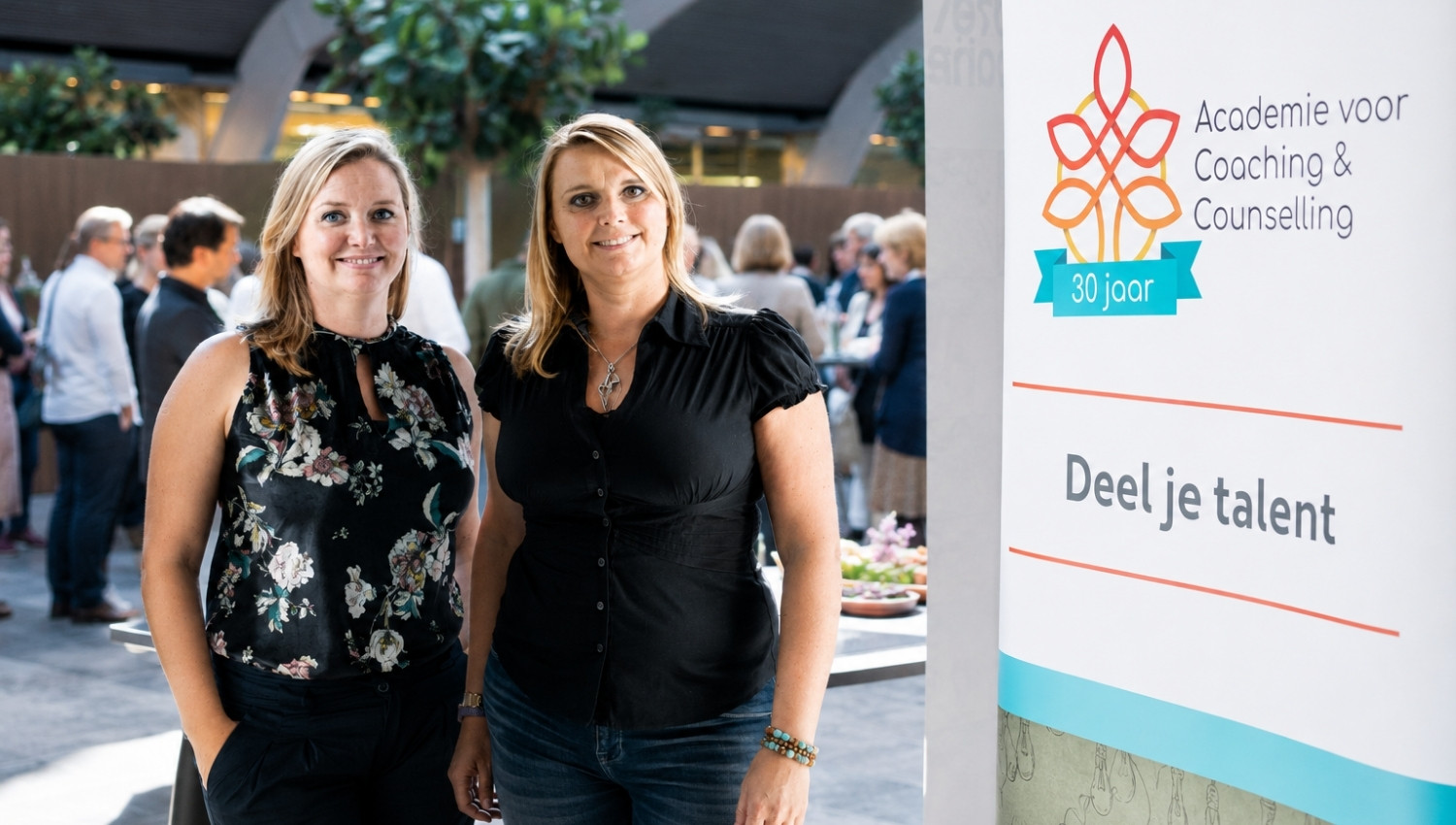
30 years Academy for Coaching and Counselling
Author: Marian Kok and Paulien Kok
The development of coaching/counselling and the ACC
This year, the Academie voor Coaching and Counselling (ACC) celebrates its 30th anniversary. A special milestone and a meaningful moment to reflect on where we come from, what drives us, and how the ACC has evolved alongside the profession of coaching and counselling over the past three decades.
30 years of coaching and counselling: from listening to meaningful development
When the ACC was founded in 1996, it entered into a professional field that was still very much developing. Coaching and counselling were still in the early stages of becoming independent professions. What we now consider to be a professional discipline was still a relatively young and new practice, shaped by insights from the field of psychology and only gradually emerging within organisations.
From that very beginning, one principle has always been central within the ACC: awareness. We believe in a world in which people, guided by a conscious and positive outlook on life, use their talents to bring out the best in themselves and in others.
Over the past 30 years, this principle has become increasingly important. Society has become faster, more complex, and often more demanding. People are faced with more choices than ever before. Many are searching for direction, meaning and balance. It is precisely in such a world that the importance of coaches and counsellors continues to grow: professionals who create space for reflection, insight and self-development.
Awareness is the foundation of personal growth. When people become aware of what truly matters to them, a space opens up to make choices that align more closely with who they really are.
- What is your personal mission?
- What talents do you possess?
- What gives your life meaning?
- What prevents you from achieving your goals and living a meaningful life?
Over the past 30 years, these questions have become increasingly important for many people. At the same time, seeking guidance in finding answers to them has become far more common. Where people once mainly turned to professional support for more serious psychological difficulties, today many more people seek guidance and mental support in a broader sense.
Coaching and counselling have grown significantly in popularity because they offer accessible and meaningful support in exploring questions like the above. Rather than providing ready-made answers, they help people gain insight, develop personally and break through unhelpful patterns.
To understand where the profession stands today, it is helpful to look back at its origins.
The 1950s: Carl Rogers, founder of counselling
The foundations of counselling lie in the work of Carl Rogers, who introduced a fundamentally different approach to guidance and therapy in the 1950s. Rather than seeing the therapist as the expert with the answers, Rogers placed the individual at the centre of the process. He believed that every person has an innate capacity for growth, provided that the right conditions are present: empathy, authenticity and unconditional acceptance.
At the time, this mainly meant creating space. Conversations took place in a calm and supportive environment in which the counsellor’s role was primarily to listen and help people explore their own thoughts and feelings. Not directing, not fixing, but simply being present. It was an approach based on a deep trust in people’s ability to grow and develop themselves.
The 1990s: coaching versus therapy
From the 1980s and 1990s onwards, coaching gradually began to move away from its therapeutic roots and found its place within organisations and businesses. Influenced by pioneers such as John Whitmore, coaching evolved into a more goal-oriented and performance-focused approach. Conversations became more practical, shorter and increasingly focused on achieving results.
Models such as the GROW model provided structure, and coaching became a widely used tool for improving effectiveness in areas such as leadership, communication and performance.
The start of the ACC in 1996
When the ACC was founded in 1996, the profession was exactly at this turning point. Coaching was growing rapidly, but its direction had not yet been fully defined. Would it develop mainly into a collection of techniques focused on performance, or would there still be room for a deeper approach to human development?
From the beginning, the ACC consciously chose the latter. Inspired by the vision of Carl Rogers, the ACC continued to place the person as a whole at the centre. Development was seen not simply as achieving goals, but as a process of awareness in which mind, heart and action are connected. At a time when coaching focused heavily on models and interventions, the ACC placed its emphasis on the quality of the human encounter
In the years that followed, coaching evolved into a mature profession. Training programmes became more professional, the number of coaches grew, and the field itself expanded considerably. At the same time, the focus within the profession began to shift. Whereas techniques and methodologies had once been at the forefront, increasing attention was given to the personal development of the coach. Gradually, it became clear that a coach works with the most important instrument of all: themselves.
From doing to being
This marked a shift from “doing” to “being”. From applying models to developing presence. From giving advice to guiding processes of learning and awareness. In many ways, the profession moved closer once again to its origins and to the principles of Carl Rogers, in which the quality of the relationship itself is essential for genuine change.
The way we understand people has also shifted. Over recent decades, there has been growing recognition that development is not purely a mental process. Thinking, feeling and the body are deeply interconnected. In a society that is strongly focused on performance and analysis, people can easily lose touch with their intuition, emotions and physical signals. Modern coaching and counselling increasingly make space for this broader and more integrated view of human development.
Meanwhile, the world in which we live and work has changed dramatically. Careers have become less predictable, the pressure to keep developing has increased, and themes such as stress, balance and purpose have become far more prominent. The coaching profession evolved alongside these developments. Whereas coaching once focused mainly on improving effectiveness, today it is equally concerned with direction, purpose and resilience.
The common thread: creating space to be fully human
After 30 years of development, one insight has become increasingly clear: at its core, coaching and counselling are not about techniques or models, but about the human encounter. About creating a space in which people can explore who they are, continue to grow, and reconnect with their own direction in life.
This appears to be the common thread throughout the years: real development takes place where people are given the space to be fully human.
And that has been the foundation of the ACC ever since 1996. The ACC consciously combines coaching, counselling and personal development: discovering who you are, recognising the patterns that may hold you back, and at the same time working towards meaningful goals and personal growth.
For 30 years, we have remained deeply committed to this foundation, and we look forward to continuing this work for at least 30 more years to come.